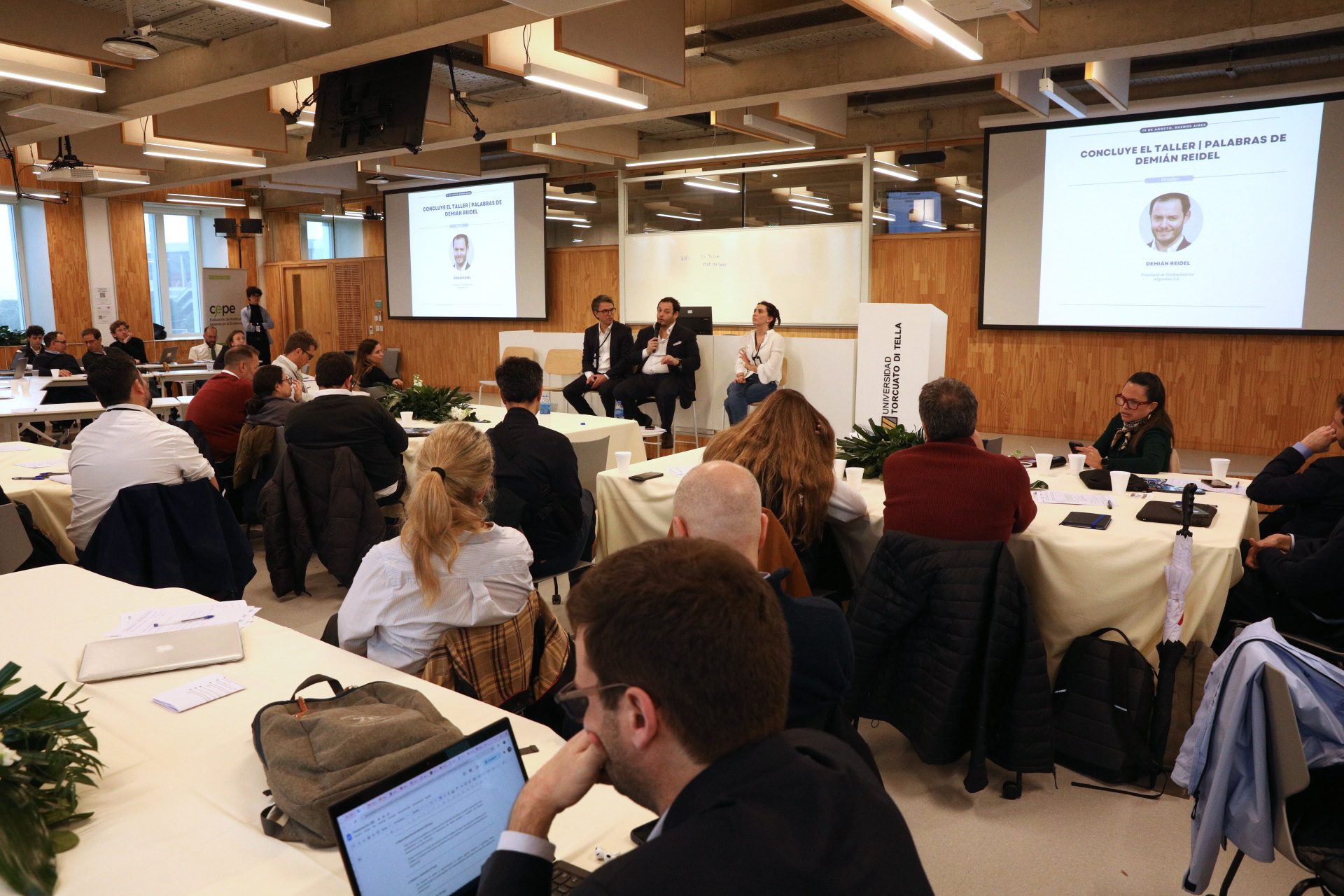
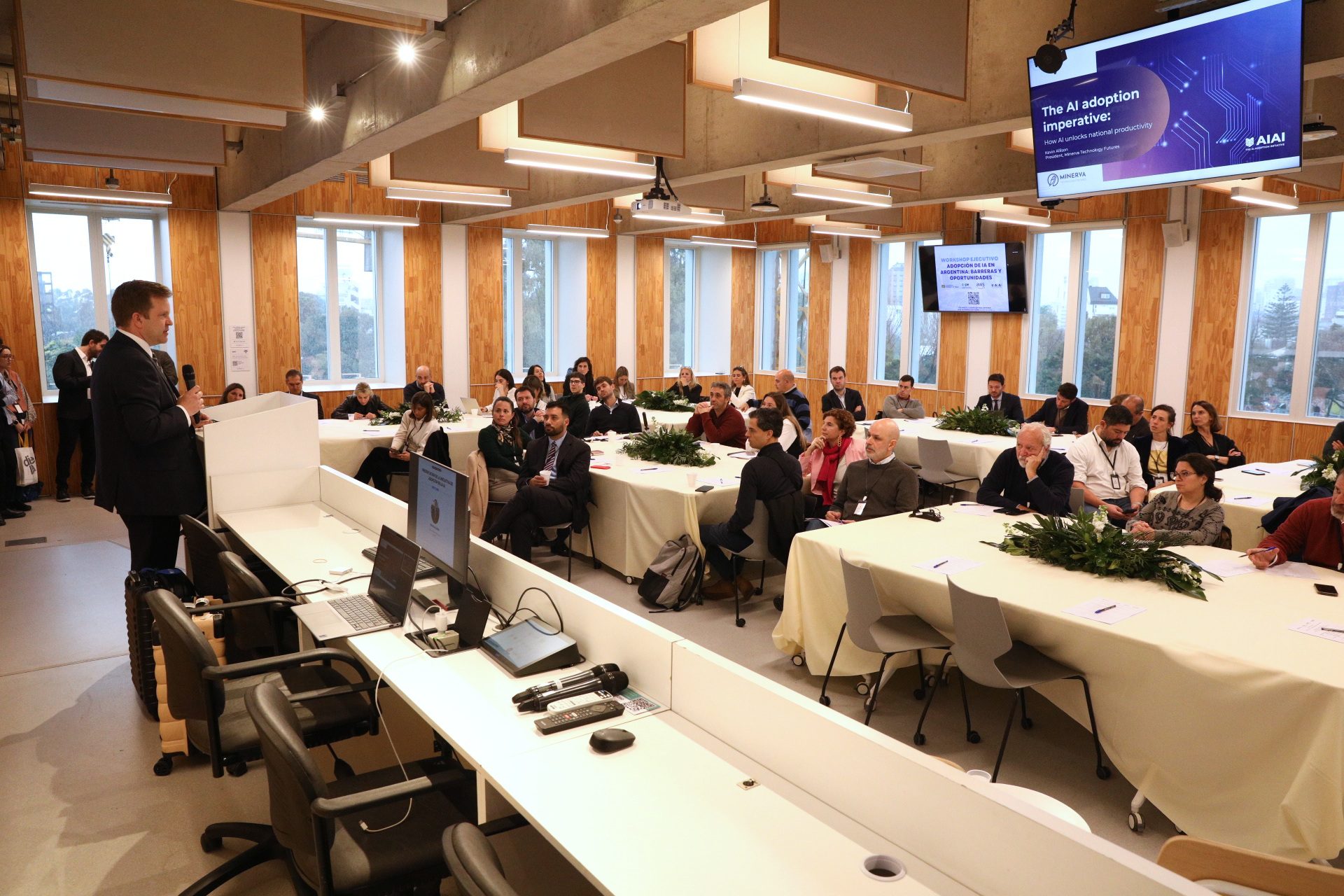
Over 50 leaders from government, business, and academia gathered at the Universidad Torcuato Di Tella in Buenos Aires for its workshop: AI Adoption: Barriers and Opportunities. The workshop marked Argentina’s first national dialogue focused on accelerating AI adoption through evidence-based, multisector collaboration.
Turning potential into progress
AI is the next great general-purpose technology – often compared to electricity or computing – whose impact depends on how widely and effectively it is adopted. While AI’s potential for productivity is clear, adoption rates remain low: globally, only 4 – 5% of companies use AI systematically, and in Latin America, adoption hovers at 2 – 3%. Closing this gap will require policies focused not just on invention, but on diffusion and applied use.
Argentina’s adoption gap
Participants agreed that Argentina faces four key structural barriers:
- Limited private investment;
- Limited digital literacy;
- Fragmented data governance; and
- Shortages of applied AI talent.
A new pilot survey on AI adoption in Argentina and Uruguay, conducted by CEPE, Fundar, and Observatorio PyME, confirmed that while local businesses – especially SMEs – express strong interest in AI, they lack the training, financing, and infrastructure to deploy it effectively.
In the public sector, participants called for a national data governance policy, common interoperability standards, and an institutionalized AI office to coordinate strategy and training. In the private sector, recommendations focused on enabling financing mechanisms, predictable data regulations, and intermediary institutions to help SMEs identify practical AI tools and use cases.
Building the workforce for adoption
Sustainable adoption depends on human capacity. The workshop emphasized differentiated training models – baseline digital literacy for all workers, advanced upskilling for strategic roles, and early AI education in schools and universities. Participants also proposed the creation of “technical translator” profiles to bridge the gap between policy, management, and technical domains.
A shared vision
Across sectors, participants recognized a common goal: Argentina must move from exploration to execution – embedding AI in public services, business processes, and workforce development. Achieving this will require strong data governance, talent, and coordinated public-private action.
As part of AIAI’s global mission, the Argentina workshop reinforces that adoption – not just innovation – is the key to unlocking AI’s economic and social potential.
Join us
AI adoption is a global challenge, and it will take collaboration to succeed. AIAI will continue to bring together voices from around the world to ensure AI becomes a tool for opportunity and growth.
Learn more and get involved: www.adopt-ai.org.
Policy Paper